
Corns
Corns (helomas) are thickened areas of skin that form in response to excessive pressure and friction. They form to protect the skin and the structure beneath it from damage. Upon walking our body weight is distributed from the heel to the ball of the foot. When the pressure is intense, growths appear either as calluses or corns, dependant upon the amount of pressure.
This pressure is not necessarily caused by walking, it can occur through ill-fitting footwear.
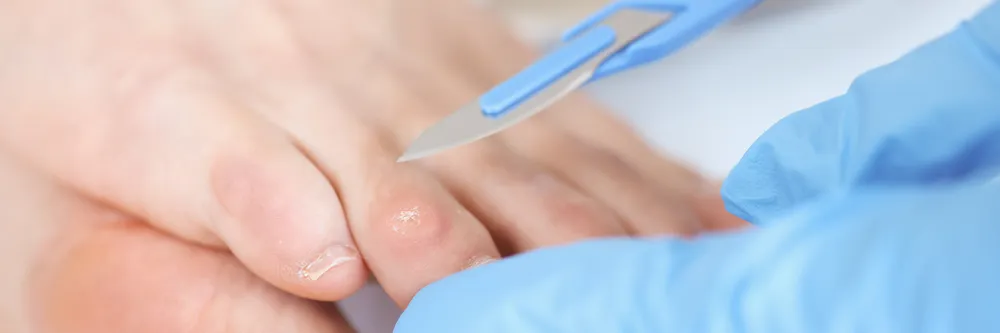
Hard Corns
These are usually about the size of a pea, and yellow in colour. They appear as a circular raised shiny patch of skin. They contain a nucleus (an inward-growing point) which can push against the underlying nerve ending thus causing sharp intense pain. In many people the toes curl downwards and do not lie flat. Fitting curled toes into ill- fitting shoes is the most common cause of hard corns, usually on the 5th (small) toe however they can occur on the tops, sides or tips of any of the toes. They can also appear under the ball of the foot, which is another pressure point.
Soft Corns
These are whitish in colour and have a rubber-like texture. They usually develop between the toes and are caused by the rubbing together of the bones in the toes.
Seed Corns
Tiny corns that tend to occur on the bottom of the foot.
Vascular Corns
These usually start as a hard corn, however through inadequate self-treatment, nerve endings and blood vessels are pushed to the surface. These will bleed profusely upon paring and can be extremely painful.
Fibrous Corns
These arise from corns that have been present for a long period of time and appear to be deeper rooted to the underlying tissue.
Treatment
Home remedies are available, either as corn plasters or liquid, however these usually contain salicylic acid, which if you are diabetic should not be used.
Excision using a scalpel is the preferred treatment by registered Podiatrist, however this will not alleviate the causative factors, i.e. tight shoes.
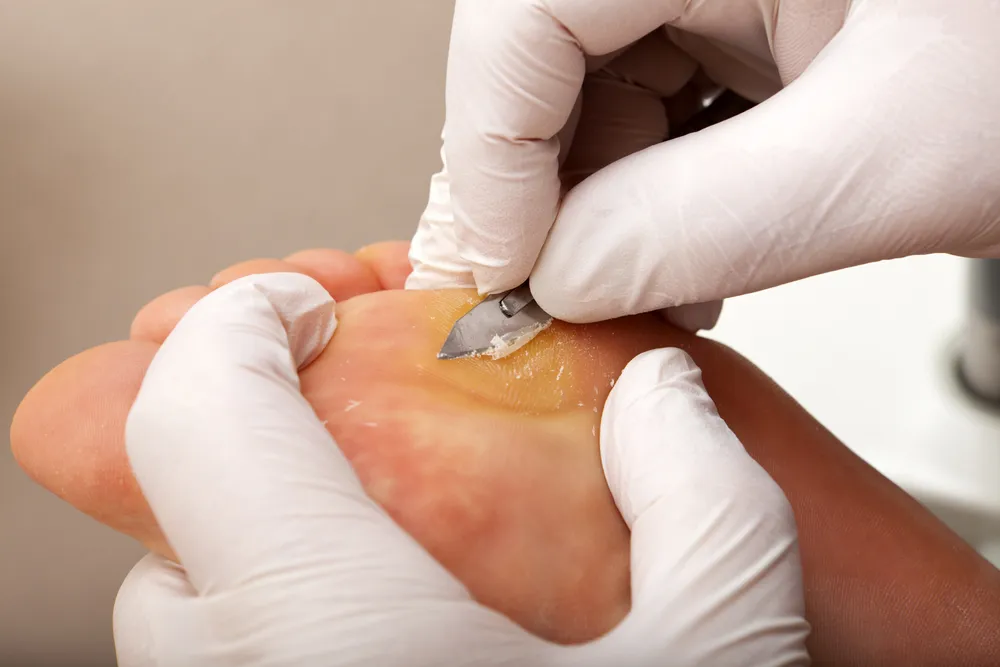
Callus
These are usually about the size of a pea, and yellow in colour. They appear as a circular raised shiny patch of skin. They contain a nucleus (an inward-growing point) which can push Calluses (keratomas or tylomas), are areas of thickened skin caused by repeated friction and pressure. They form to protect the skin and the structures beneath it from injury or damage and can develop on any part of the body.
On the feet, calluses usually develop on the sole of the foot, commonly on the heel or at the ball of the foot under the metatarsal heads. This is because these are the areas where a majority of the pressure is taken. If not removed, callus thickens, causing added pressure against the skin and may cause pain. Calluses on the foot can develop into corns. Calluses may also form through wearing ill-fitting shoes, which cause friction against the skin. Wearing suitable shoes with correct width and depth, soft soles and lower heels may help to prevent calluses. Whilst the build-up of hard skin on the foot is natural, bony deformities (such as bunions), and an incorrect walking action can all contribute to the formation of calluses.