
Calluses
Calluses (keratomas or tylomas), are areas of thickened skin caused by repeated friction and pressure. They form to protect the skin and the structures beneath it from injury or damage and can develop on any part of the body.
On the feet, calluses usually develop on the sole of the foot, commonly on the heel or at the ball of the foot under the metatarsal heads. This is because these are the areas where a majority of the pressure is taken. If not removed, callus thickens, causing added pressure against the skin and may cause pain. Calluses on the foot can develop into corns.
Calluses may also form through wearing ill-fitting shoes, which cause friction against the skin.
Wearing suitable shoes with correct width and depth, soft soles and lower heels may help to prevent calluses. Whilst the build-up of hard skin on the foot is natural, bony deformities (such as bunions), and an incorrect walking action can all contribute to the formation of calluses.
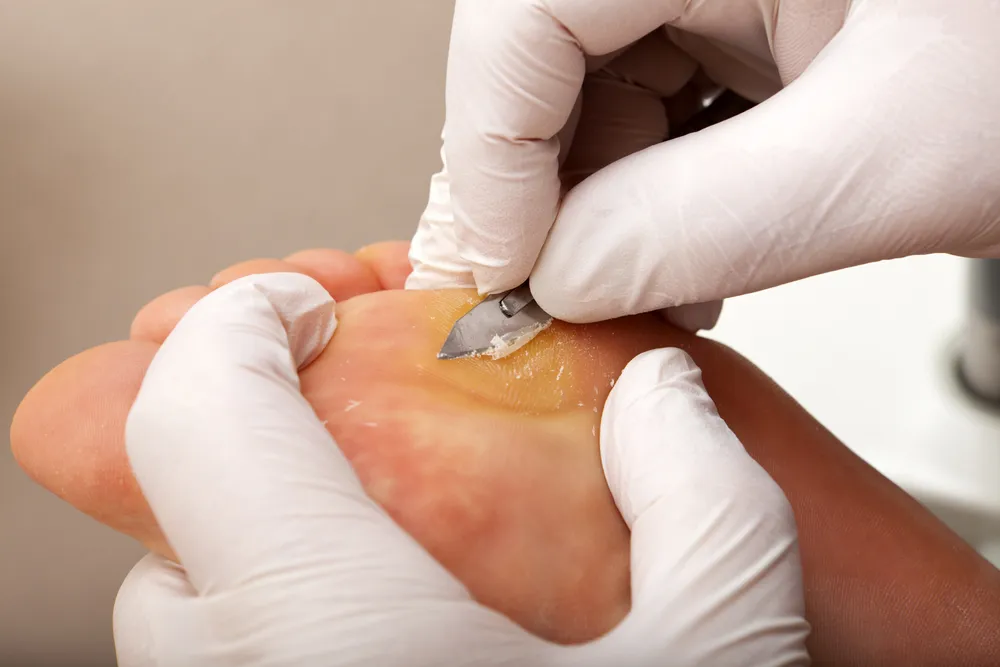
Signs and symptoms
Calluses are thickened areas of skin usually creamy yellow in colour, without distinct borders. They are similar to corns, however with no central nucleus pressing down on the nerve end. They therefore tend to cause a wider spread burning sensation, rather than the sharp pain associated with corns. Where there is concentrated pressure on the affected area, the top of the callus may take on a shiny veneer and the surrounding skin can appear reddened.
Treatment
A small amount of callus can be treated at home, with the use of a pumice stone or foot file, however if the callus is painful than professional treatment should be sought. Diabetic persons should consult a registered Chiropodist for all foot abnormalities, including calluses.
Nail Cutting Services
Nail conditions can be challenging and often uncomfortable to manage at home, particularly when the nail has become thickened, distorted, or infected. Our professional nail cutting service is designed to safely treat a wide range of common nail pathologies, helping to relieve pain, reduce complications, and improve nail health.
The most common nail conditions we treat include:
Onychauxic nails – A thickened nail plate caused by factors such as trauma, fungal infection, ageing, or poor circulation. These influences affect the nail matrix, leading to abnormal nail growth and hypertrophy.
Onychogryphotic nails – Severely thickened nails with a distorted or claw-like growth pattern. This condition is often associated with trauma, long-term neglect, or genetic factors and can make routine nail care extremely difficult.
Onychomycotic nails – A fungal infection affecting the nail bed and nail plate. It may develop due to poor general health, nail trauma, warm or humid environments, compromised immunity, or prolonged use of tight or occlusive footwear.
Onychocryptotic nails (ingrown toenails) – Occur when the nail edge penetrates the surrounding skin, causing pain, redness, swelling, discharge, odour, and sometimes over-granulation tissue. Common causes include excessive sweating, incorrect nail cutting, trauma, and naturally curved nails. While many cases can be managed conservatively, nail surgery may be the most effective option to prevent recurrence in persistent cases.
Involuted nails – Nails that curve excessively from side to side. This condition may result from excessive sweating, repeated trauma, pressure from footwear, or hereditary factors.
Corns
Corns (helomas) are thickened areas of skin that form in response to excessive pressure and friction. They form to protect the skin and the structure beneath it from damage.
Upon walking our body weight is distributed from the heel to the ball of the foot. When the pressure is intense, growths appear either as calluses or corns, dependant upon the amount of pressure.
This pressure is not necessarily caused by walking, it can occur through ill-fitting footwear.
Corns are usually hard and circular, with a translucent centre. They can become painful or ulcerated in response to the severity of pressure.
There are 5 different types of corn, however the two most common are hard corns (heloma durum) and soft corns (heloma molle).
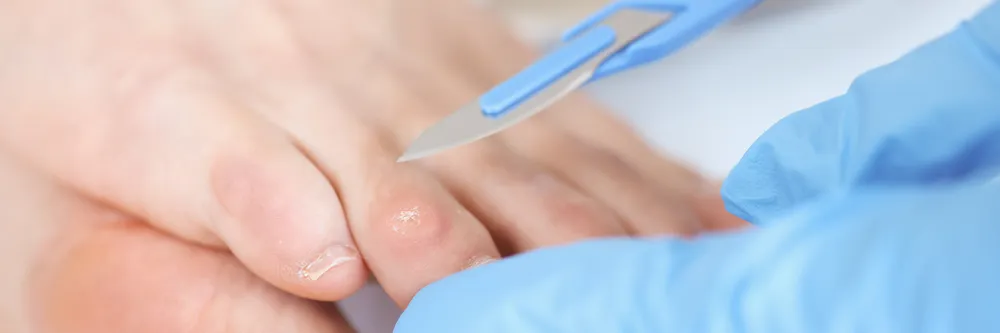
Hard Corns
These are usually about the size of a pea, and yellow in colour. They appear as a circular raised shiny patch of skin. They contain a nucleus (an inward-growing point) which can push against the underlying nerve ending thus causing sharp intense pain.
In many people the toes curl downwards and do not lie flat. Fitting curled toes into ill- fitting shoes is the most common cause of hard corns, usually on the 5th (small) toe however they can occur on the tops, sides or tips of any of the toes. They can also appear under the ball of the foot, which is another pressure point.
Soft Corns
These are whitish in colour and have a rubber-like texture. They usually develop between the toes and are caused by the rubbing together of the bones in the toes.
Seed Corns
Tiny corns that tend to occur on the bottom of the foot.
Vascular Corns
These usually start as a hard corn, however through inadequate self-treatment, nerve endings and blood vessels are pushed to the surface.
These will bleed profusely upon paring and can be extremely painful.
Fibrous Corns
These arise from corns that have been present for a long period of time and appear to be deeper rooted to the underlying tissue.
Treatment
Home remedies are available, either as corn plasters or liquid, however these usually contain salicylic acid, which if you are diabetic should not be used. Excision using a scalpel is the preferred treatment by registered Podiatrist, however this will not alleviate the causative factors, i.e. tight shoes.